
Among the beauties that make up Piazza Aranci, the Palazzo Ducale, founded by Prince Alberico I Cybo-Malaspina, represents one of the city’s most impressive monuments. The purpose of its construction was to give the city prestige and beauty, able to compete with Italian Renaissance principalities. It was founded between 1567 and 1570, a period when the first core of the palace was built. Over the years the residence then underwent several modifications: this can be easily understood by observing the main elevation of the palace.
Over the course of time Alberico il Palazzo’s successor, Charles I, in honor of the grandeur of the family of Veronica Cybo, his wife, decided to introduce a reception hall inside the palace and expanded the building by adding the Salone degli Svizzeri. This involved moving the front door, which was enriched with a terrace decorated with marble friezes and statues. Thereafter, Alberic II, successor to Charles I, continued to expand the palace by building a third loggia, constructed around 1670 by Giovanni Francesco Bergamini. The wing in fact still represents an example of a 16th-century courtyard.
Teresa Pamphilj, wife of Duke Charles II then decided to adorn the complex with 100 marble columns. This gave the palace an uneven style, and for this reason, inspired by Roman Baroque palaces, Teresa commissioned Alessandro Bergamini to harmonize the main facade. Alessandro Bergamini’s ingenuity in masking the asymmetries of the Palazzo Ducale of Massa consisted in using contrasting colors, particularly cybeo red and white marble. The most excellent choice for two reasons: it helped create a harmonious and elegant visual effect, and it softened the structural imperfections that emerged due to the technical difficulties of the time.
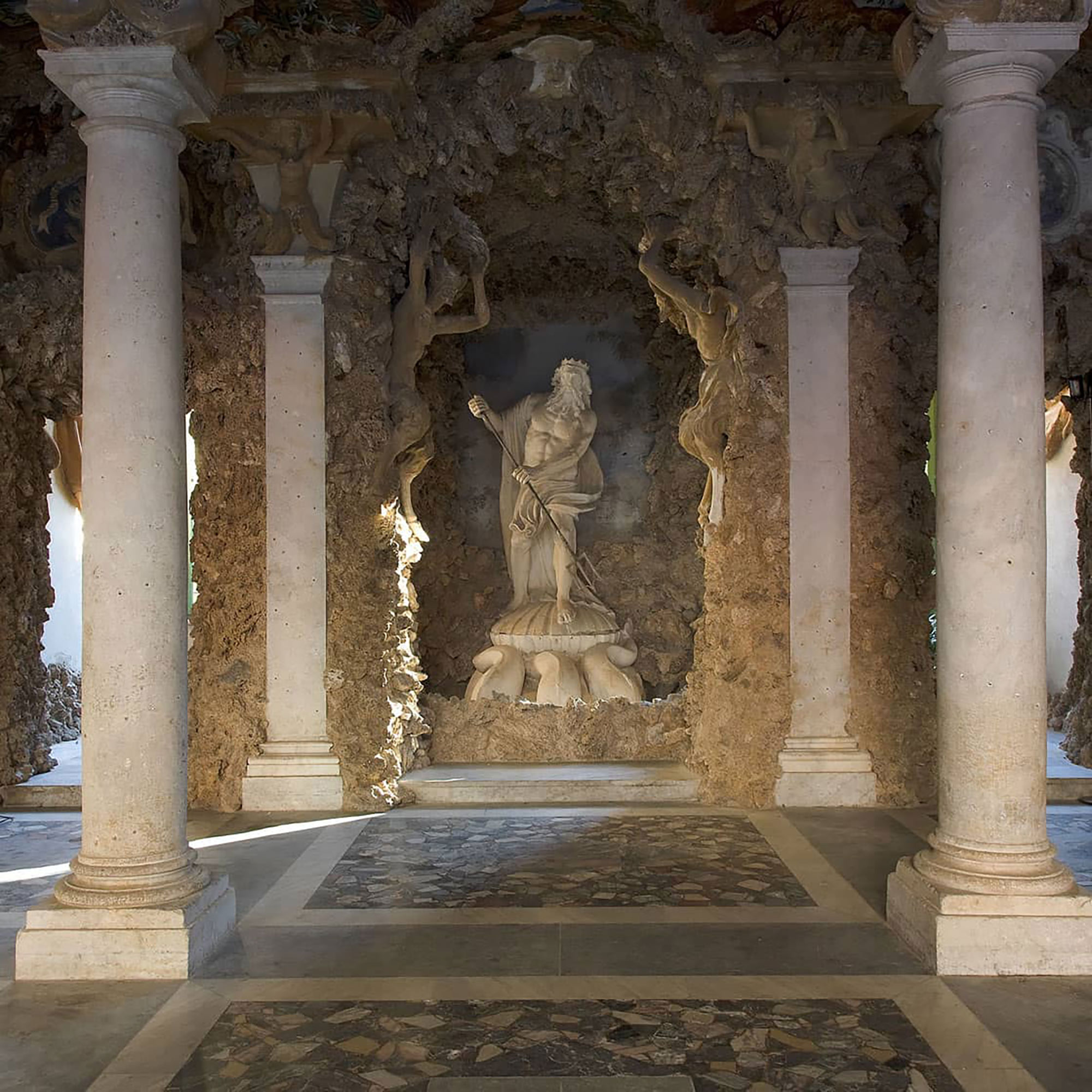
Today inside the courtyard of the palace hidden from prying eyes is the Grottesco or Neptune’s Cave, an evocative place where it is possible to discover the marble statue of the god of the sea. The cave environment, deliberately covered with limestone encrustations that make it almost a submerged sea cave, is decorated with two satyrs holding up the entrance and a statue of Neptune emerging from the waves on three Carrara marble dolphins. The two adjacent rooms inside the cave, on the other hand, are decorated with frescoes painted by Stefano Lemmi in 1702. In the vaults, as evocative as the entire cave, are depicted The Manifestations of Human Ingenuity and The Glorification of the Four Pontiffs of the Cybo and Pamphili families.
The Palazzo Ducale in Massa thus represents a cultural landmark of considerable importance to the city. Inside, various rooms testify to its history and multifunctionality. Among its most significant spaces are the Salone degli Svizzeri, the Salone della Resistenza and the Salone degli Stucchi, characterized by decorations that reflect the elegance of Baroque architecture of the period. To date, the spaces are not accessible to the public as part of the Prefecture’s offices. Also bearing witness to the palace’s important past is the Ducal Chapel, decorated with frescoes by Carlo Pellegrini on the vault and enriched by a marble bas-relief depicting the Nativity on the altar. The Ducal Alcove, executed by Alessandro Bergamini between 1695 and 1696 with its story and artistic details, is also evidence of the court’s artistic traditions. In addition to this, the palace housed the Ducal Theater, which helped add further prestige and refinement to the ducal residence. Despite the transformations undergone over time, the Palazzo Ducale continues to be a symbol of historical and cultural identity for the city of Massa. Thanks to its architecture, the residence provides an ideal setting for hosting cultural events of various kinds. Art exhibitions, often focusing on local works, give visitors the opportunity to appreciate historical and contemporary masterpieces. Through the programming of events, exhibitions, and lectures, the mansion thus preserves its past while celebrating the contemporary.