
A walk through Renaissance Massa can only begin at the monumental Porta Martana, the ancient entrance, for those coming from Tuscany, to the modern city desired by Prince Alberico I Cybo Malaspina (1568-1623).
The sixteenth-century circle of walls gave shape to a new city, enriched by the many buildings willed by Alberico, and by the dwellings of the notables who gravitated around his court: the date of the laying of the first stone of the walls (June 10, 1557), is still hailed with great prominence in the city, with the events that commemorate the “Foundation of Massa Nova,” and the jousting of the “Quintana Cybea.”
Passing through the solemn arch of the gate, one enters the scenic Piazza Martana, where the three main axes of the city imagined by Alberico converge, the present Via Alberica, Via Beatrice and Via Bigini; on the left were the ducal stables (1557), access to which was through the airy portico still clearly visible.
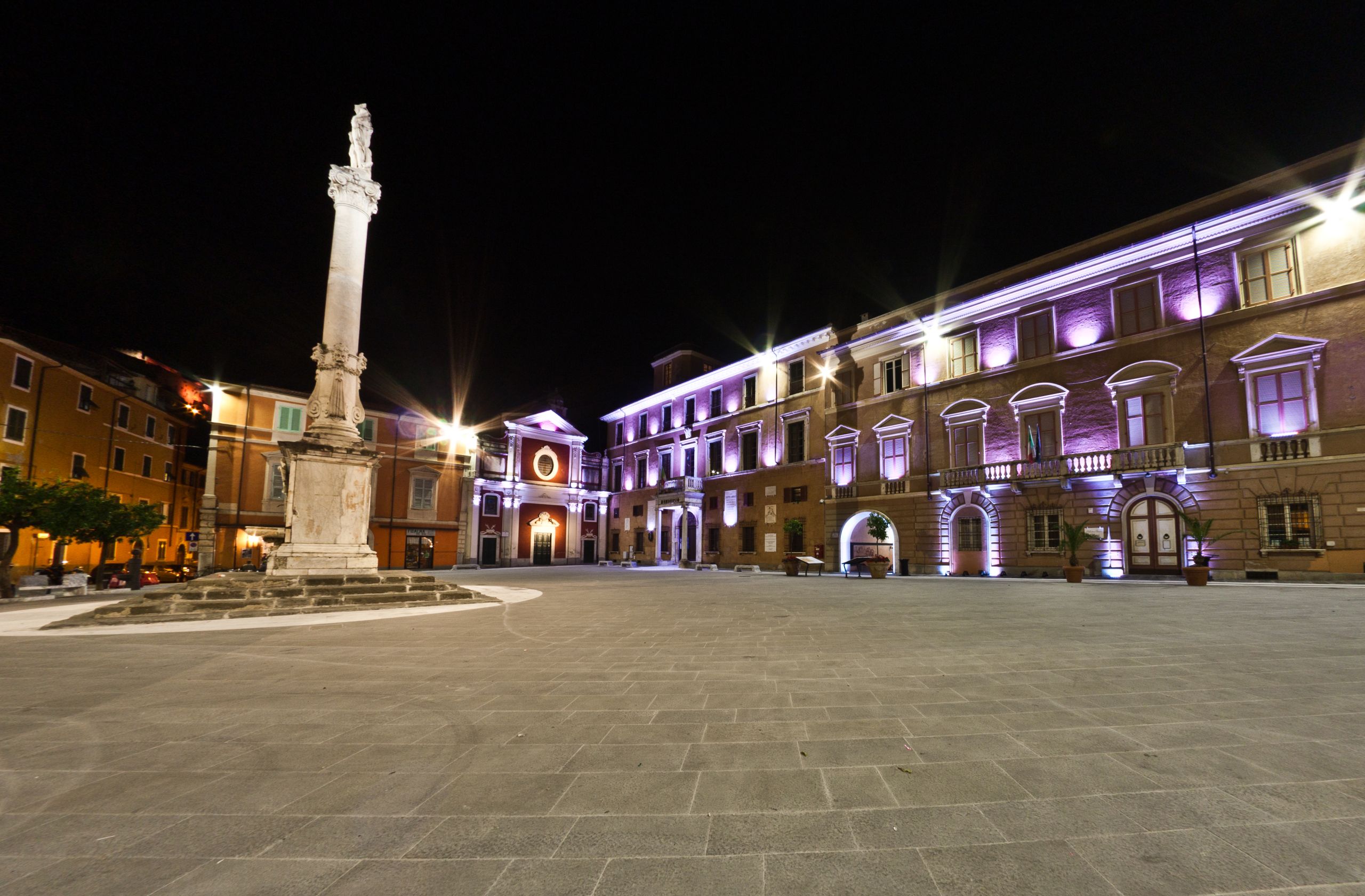
Continuing along Via Beatrice, one reaches in a few minutes the central Piazza Mercurio, the ancient market square of Massa, where the prince had a fountain erected, surmounted by an image of Mercury, god of commerce and money. The present monument, consisting of a tall marble column rising from a base with a fountain, is 18th century, while the statue of Mercury above it is a modern (1980) copy, designed to replace the original, which was badly damaged by bombing in 1944. The 17th-century church of San Giovanni Decollato and the adjacent Bourdillon Palace also insist on the square; the portal is 19th-century, but the structure of the residence dates back to the 16th century, when it was owned by the noble Staffetti family.
A modern underpass leads to Via Alberica, where we turn right to meet, a short distance away, the former Palazzo dei Cadetti (1580), built by Alberico to house members of the Cybo family. Repurposed as a bishop’s seat, the building has housed the Diocesan Museum of Massa since 2003, where an interesting marble Madonna and Child (1428) by Michelozzo (1396-1472), and the wooden statues of St. Leonard (1420) by Jacopo della Quercia (1374-1438), and St. Roch (1525) by Domenico Gare (†1529), along with other works and furnishings from churches and convents in the area , arepreserved .
Via Alberica flows into the wide Piazza Aranci, dominated by the great bulk of the Ducal Palace, a symbol of power and the focal point of the Alberician city: the ancient house of the Marquis Malaspina was enlarged several times, starting in 1563, with modifications and subsequent additions continuing until the end of the 17th century. Behind the grand 17th-century façade, enriched by a sumptuous decorative apparatus in marble and stucco, is a luminous courtyard surrounded by marble loggias of Renaissance design. The palace chapel contains, in a later altar, a valuable 16th-century bas-relief of the Nativity, a work of dubious attribution, attributable to the work of one of the many sculptors active in Carrara in the early decades of the 16th century.
From Piazza Aranci, turn into Via Dante Alighieri, dominated by the tall modern facade (1936) of the cathedral, dedicated to St. Francis; the church was entirely rebuilt between 1660 and 1670 but preserves, in the Cybo Malaspina burial ground, the precious tombs of Eleonora Malaspina, made in 1516 by Lombard sculptor Pietro Aprile (1477-1558ca.), and of Lorenzo Cybo, father of Alberico I, a work of uncertain attribution (perhaps from the Gagini workshop), executed around mid-century. Both tombs have undergone rework and restoration, making it difficult to reconstruct their original appearance, but the lying figures of the two deceased do not fail to exert great fascination on contemporary visitors.
At the exit, on the corner with Guglielmi Street, the Mussi-Ayola palace preserves one of the most important traces of the ancient “Massa Picta.” The abundance of decorated facades, with wall paintings, frescoes and graffiti, characterized the city for centuries, beginning in the late 16th century, when Michel de Montaigne told of the “beautiful houses, and painted” seen in Massa on his trip to Italy (1581). The decorations graffitied on this palace constitute valuable historical as well as artistic evidence, depicting places in the ancient city that have been profoundly transformed today, from the convents of St. Francis and the Capuchins, to the garden of the Pomerio Ducale, and including a view of a tower of uncertain identification.
On the opposite side of the cathedral façade is Via Zoppi, which continues to the intersection with Via Cavour, where Casa Landi stands, the most interesting and complete of the survivals of the ancient painted city: the façade graffiti has been interpreted as a complex allegorical tribute to Alberico and the Cybo family. The façade on Via Zoppi is in fact embellished with six laurel wreaths in which appear the peacock feat of Pope Innocent VIII (1432-1492), the burning barrel feat of Francesco Cybo (1449-1519), the anvil on a stump of Cardinal Innocent (1491-1550), the imperial eagle, and the cube and stork feat (barely legible) of Alberico. The elevation on Via Cavour repeats the pattern of the previous one, with five crowns in which appear the portraits of Hannibal, Scipio Africanus, Porsenna, Pompey the Great and Julius Caesar, famous ancient condottieri, placed in parallel with the modern princes of the House of Cybo.
The itinerary cannot leave out a visit to the Rocca Cybo Malaspina, a castle of medieval origin, transformed into an elegant Renaissance residence during the 16th century. The complex can be reached on foot, departing from Piazza Mercurio, going up the ancient Piastronata path; the walk is uphill and takes about a quarter of an hour. At the beginning of the ascent is Palazzo Maggesi (Via della Piastronata, 8), whose facade preserves the remains of a wall decoration attributed to the painter Agostino Ghirlanda (1535/40-1588).
The castle is currently undergoing restoration and redevelopment: the construction site, opening in 2024, is financed with funds from the National Recovery and Resilience Program.