
Today fully integrated into the urban fabric, but once located in the open countryside, the church of San Francesco di Carrara, with its convent, scenically closes the perspective of Via Verdi (once Stradone di San Francesco), the main axis for the development of the nineteenth-century city.
A high staircase, dating from 1643, leads to the beautiful loggia of the late 17th-century facade.The complex was erected in several phases, the first of which dates back to the late 16th century and the Reformed Conventual Friars. These were succeeded in 1628 by the Franciscan Minor Observants, who enlarged the original nucleus with the help of Marquis Carlo I Cybo Malaspina. During the 18th century the new bell tower was erected (1747) and the convent building was greatly enlarged, enriched by a new cellar and a well-stocked library.
During the Napoleonic period the body of the church was entrusted to the Parisian painter Jean-Baptiste Desmarais (1756-1813), called to teach at the local Academy of Fine Arts, who made it a sculpture studio, saving it from total despoliation. Having become municipal property, the convent then experienced new uses, lending itself to hosting elementary, gymnasium and technical schools and also serving, for short periods, as a hospital or barracks. While the church, from 1920, was reopened for worship, the rest of the complex was then abandoned and houses, after a long restoration completed in 2006, the MudaC (Carrara Arts Museum).
The church’s interior, recently restored, has a rectangular plan and a single nave, following a widely used pattern for conventual churches of the Counter-Reformation; the layout is very simple but enriched over the centuries by numerous works of architecture and marble sculpture from the local school.
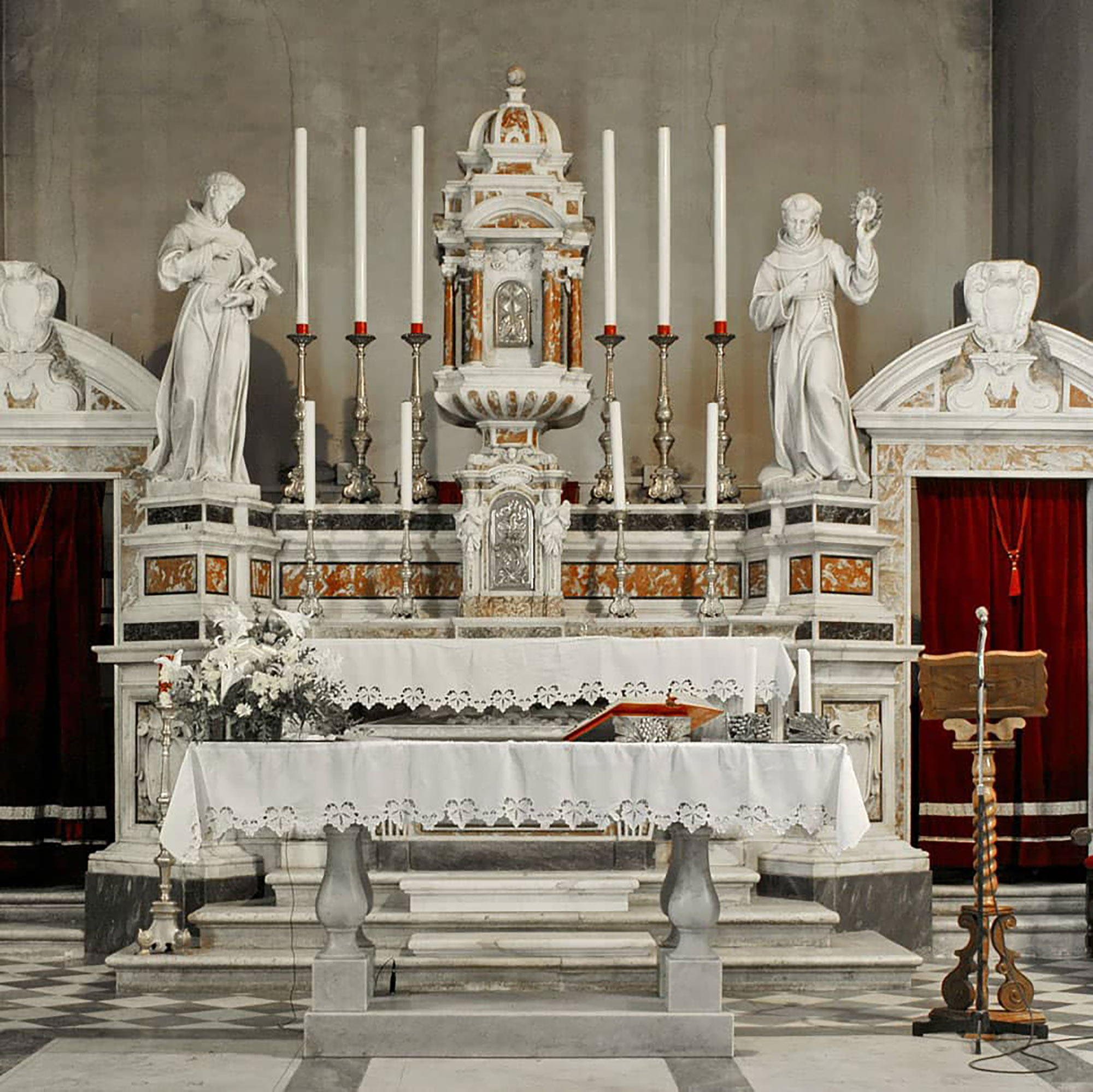
The high altar, executed between 1627 and 1643, falls into the category of retabulum altars, with side-by-side doors, widely diffused in the area and traceable to models that came out of the Bergamini workshop. The statues of Saints Francis and Bernardine of Siena, on the other hand, date from 1767 and are the work of Giovanni Antonio Cybei (1706-1784), replacing earlier specimens later placed in the niches of the facade.
Prominent on the right side of the church is the altar of St. Anthony of Padua, made in the late 17th and early 20th centuries by the Lazzoni workshop: conceived as an exuberant scenic machine, the altar is richly inlaid, with extensive use of colored marble and two precious twisted columns in Rosso di Francia. The central statuary marble altarpiece, with theVirgin and St. Anthony of Padua, is a valuable work by Tommaso Lazzoni .
On the opposite wall, the altar of the ImmaculateConceptionhouses a marble Immaculate Conception that adorned the city’s ancient Sea Gate: said to be the work of a sculptor from the Casserini family, reworked by Tommaso Lazzarini in the mid-19th century. To the left follows the altar of the Crucifix, erected between 1759 and 1768 to house a relic of the wood of the holy cross donated by the sculptor Cybei, and adorned with a coeval wooden Crucifix of the Genoese school .
To Giovanni Antonio Cybei, who was a priest as well as an artist and the first director of the Academy of Fine Arts in Carrara, also refers the tombstone (placed on the floor of the church near the altar of the Sacred Heart) of Sister Fedele, born Antonia Margherita Cybei (1707-1784) and younger sister of the sculptor. The touching inscription reveals how the latter had lovingly cared for her brother, who was stricken with a serious illness: having healed John Anthony, however, it was Fedele who fell ill, losing his life. Abbot Cybei, “frater superstes,” did just in time to dedicate this beautiful plaque to his “dilectissima” sister, whom he joined within a few months, passing away in September of that same 1784.