
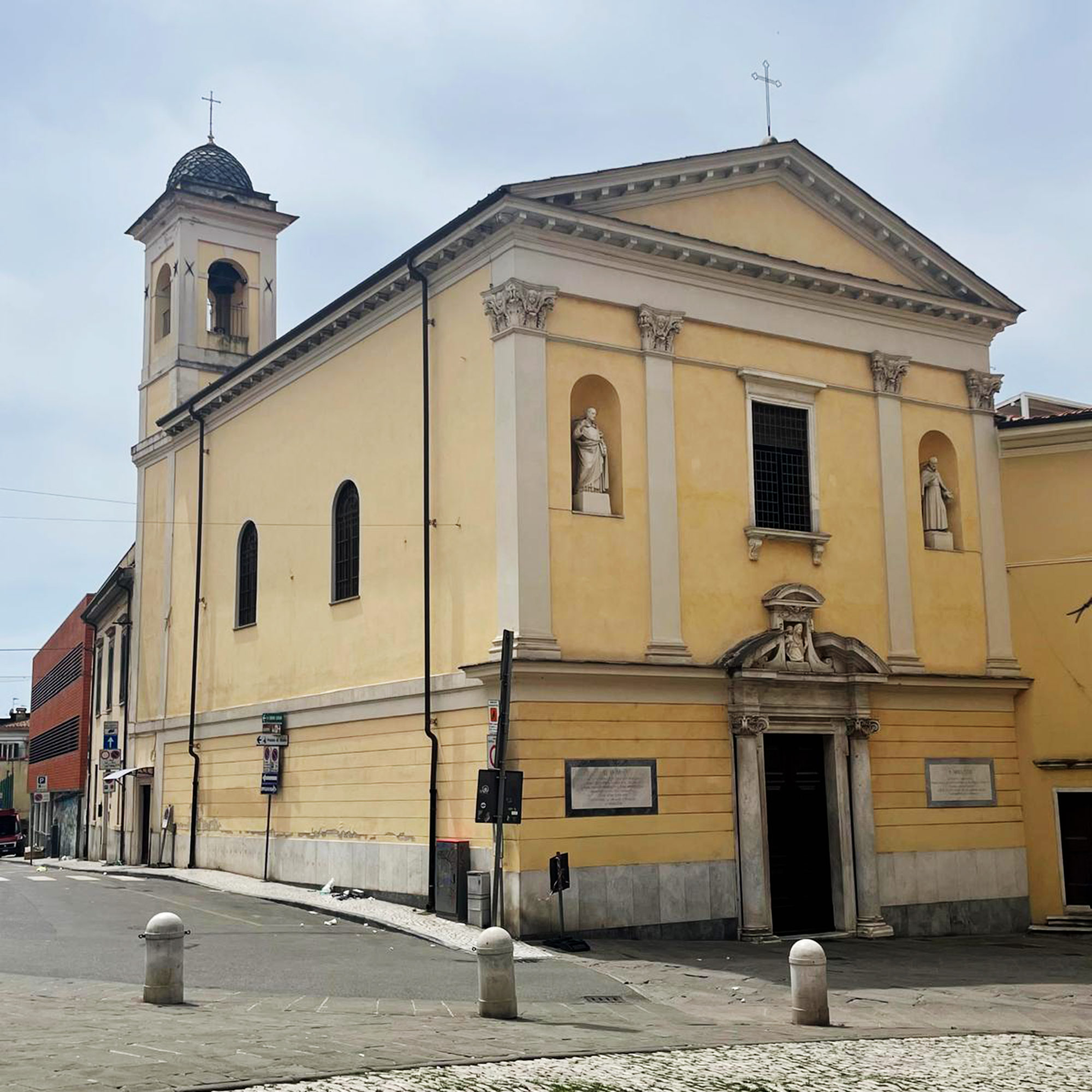
The Carmine Church stands at a crucial junction in Carrara’s historic center, where the very ancient Via Santa Maria and the solemn Via Loris Giorgi (formerly Via Alberica) meet to flow into what is now Piazza Mazzini, a majestic space dominated by the princes’ palace. This is where the two main perspectives of the old city intersect, the one that, starting from Piazza Alberica, frames the great portal of the sovereign palace, and the other that concludes the medieval city by placing at the head of Via Santa Maria the façade of the Carmine; it is no coincidence that, the current pedestrian zone of the center, begins from this very point.
The land, on which the building stands, was donated to the Carmelite fathers in 1587 by the first prince of Massa and marquis of Carrara Alberico Cybo Malaspina, on a site included in the new city walls, whose perimeter encompassed a much larger area than that of the ancient medieval circle. By 1596 the church was completed in its basic structure, and in the early seventeenth century, while beautification work continued, the adjoining convent was erected.
The Carmelite fathers were also entrusted with the education of children, with the opening of a school (1593), where younger children would learn to “read, write, conjugate, give concordances.” The school remained active, with ups and downs, until the late 18th century, even hosting the first meetings of the “Aruntica” literary academy (1793).
In the Napoleonic period the entire complex became the site of the government sculpture ateliers, where imperial busts were made in series, copies of ancient statues and elegant architectural works in marble. In 1807 it was proposed that the altars be completely removed from the building, an eventuality that, fortunately, was not followed through on for economic reasons.In May 1808 the new studios were officially inaugurated, with the workshops finding space in the convent premises, and the church converted back into the “Galleria dei Carraresi,” a permanent exhibition space in which the most recent works of local sculptors were presented to the public.
With the restoration came the reopening of the church for worship, while the convent remained in private hands: after also being used as a barracks and post office, for a short period, it was then fractionated and houses, to this day, housing and various businesses. Since 1961 the Carmine was governed by the Jesuit fathers, who settled in a modern facility along July VII Street, and in 2000 it was finally entrusted to the Missionary Fathers of Mary.
The rigorous 19th-century facade (architect Giovanni Ugolini, 1853), incorporates the oldest marble portal (1623), with a fine Madonna della Rosain the center , possibly from the oratory of the Compagnia della Rosa, a confraternity housed in the Carmine until 1650. It is attributed to the Spanish sculptor Bartolomé Ordóñez (1480-1520), who spent the last years of his life in Carrara, engaged in the creation of the monument to Philip of Burgundy and Joan the Mad for the Royal Chapel of Granada.
Theinterior has the sober and austere features of the late 19th-century restoration by Count Carlo Lazzoni (†1885): the high altar (1599) houses a painting ofOur Lady of Mount Carmel attributed to the Sarzano painter Domenico Fiasella (1589-1669). The Virgin, with the child in her arms, is depicted passing the Carmelite scapular to St. Simon Stock, protector of the order, behind whom can be glimpsed St. Albert of Trapani and a pair of elegantly dressed figures, perhaps the commissioners of the work. On the opposite side are Saint Charles Borromeo, kneeling, and Saint Angel of Jerusalem. In the background is a bearded figure that popular tradition interprets as a self-portrait of the painter, but more likely represents another Carmelite saint.
Among the altars in the nave (note that of the Crucifix, with a 17th-century cross, and the other dedicated to Our Lady of Mercy), the one dedicated to Santa Maria Maddalena dei Pazzi stands out for its monumentality: completed in 1685, the altar was erected at the behest of Count Francesco Maria Diana, a member of one of the first noble families of Carrara. Its realization was entrusted to the sculptor Giovanni Lazzoni (1618-1687), who placed his signature on the base of the central statue. The architecture is simple but richly decorated: four little angels, with symbols of the Passion, occupy the main portion of the altar, surrounding the portoro marble niche, with a shell-like calva, that encloses the image of the saint. Dressed in the Carmelite habit, Mary Magdalene holds a heart in her right hand, on which the words of John’s Gospel “Verbum / Caro / Factum / Est” stand out, while holding a crucifix with her left. The delicate pathos of the expression and the dynamism of the work, with the edges of the robe seeming to follow the spiritual motion of the saint, make this sculpture Lazzoni’s masterpiece, and the entire altar, the artist’s last work, is among the most remarkable in the entire province.