
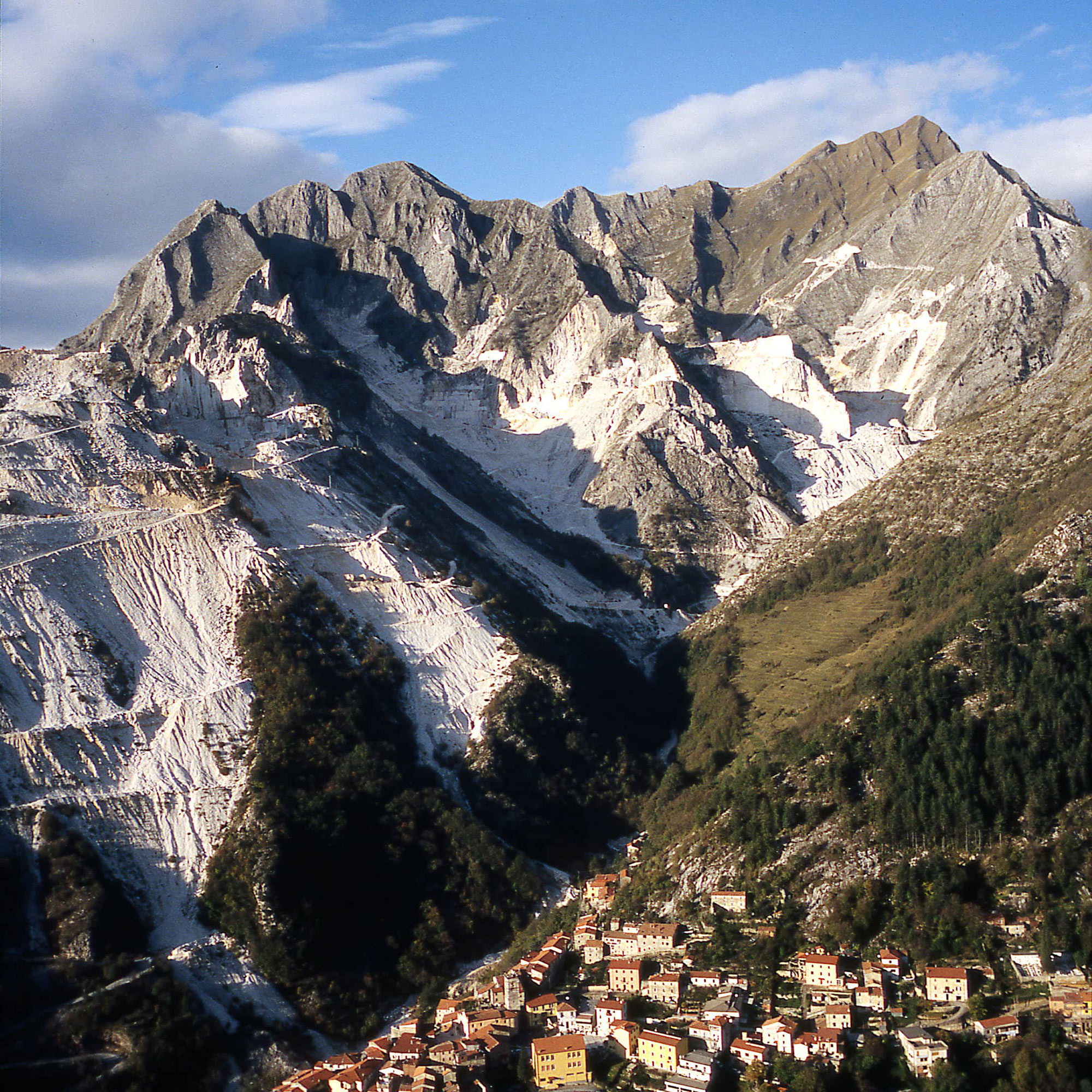
Perched among the Apuan Alps, over five hundred meters above sea level, Colonnata retains the charm of the old quarrymen’s village, combined with the attraction exerted by the production and sale of the renowned Lardo di Colonnata IGP.
This delicious cured meat, prepared for centuries in the town’s cellars, was long considered a poor dish, a meal laden with energy for quarry workers or for the anarchists who took refuge in the mountains after the uprisings of 1894. Reevaluated, thanks to the resourcefulness of some producers, it was granted Protected Geographical Indication status in 2002: the production area is very restricted, as are strict rules on aging. Made from the backs of adult pigs, Lardo di Colonnata must be processed with natural sea salt, ground black pepper, fresh rosemary and garlic, while the use of herbs and other spices such as cinnamon, nutmeg, cloves, etc. is optional. Freeze-dried substances, flavorings, preservatives and additives are to be excluded. The element that most characterizes this ancient product, however, is the traditional curing process in special marble vats called conche, once made by hand from a single block, today more frequently composed of slabs welded together appropriately. After a period of at least six months, the lard will have released a large amount of “brine,” thanks to prolonged contact with salt, and will be ready for consumption.
Some tell how Michelangelo himself, upon reaching the mountains of Carrara, stocked up on lard, but if Buonarroti’s preference remains only a popular legend, the presence in the village of centuries-old hollows reveals the antiquity of this particular form of processing. A tradition, made up of curing and refining, that reflects the history and peculiar culture of the entire Carrarese territory, whose products were unable to meet the needs of the entire population, largely employed in the marble economy, since the 18th century. Meats (and many other food products), were therefore imported from neighboring areas and then “accommodated” for curing locally. This explains why, even today, lard is not processed from meat from animals raised in the village (where it would not be physically possible) but from a small number of Italian regions, and processed fresh within 72 hours of slaughter.
The village still retains its medieval layout, with narrow alleys inviting visitors to discover its thousand-year history, made up of a very close relationship with the world of quarrying. The numerous artifacts found in the surrounding area reveal how these places have been frequented since Roman times, and the first settlement of Colonnata was perhaps born as a refuge for the earliest workers in these valleys.
The town’s parish church, appropriately dedicated to St. Bartholomew, patron saint of butchers, is located at the highest point of the town, and is preceded by the monument to the quarryman (1983) by Alberto Sparapani (1911-2004), in which the various stages of the marble extraction process are depicted, from the securing carried out by the “tecchiaioli,” to the cutting with the helical wire, to the transport with the “lizza,” the rudimentary wooden sled that, supported by ropes, allowed the blocks to be lowered to the quarry floor. Not to be missed among the reliefs is the figuration of an imposing “varata,” an explosion capable of bringing down a large portion of the mountain to open new mining veins, in a grandiose and “terrible” spectacle that fascinated (among many) Umberto Boccioni and Gabriele d’Annunzio.
Inside the church, documented from the 12th century but rebuilt in the 16th century, sculpture predominates: fragments of the building’s primitive altarpiece, made by the Florentine Andrea Guardi (†1476), are walled in the chancel. The three surviving figures, datable to the 1460s, depict St. Bartholomew and, within elegant niches in classical style, St. Peter and St. Andrew. In the nave an altar with a relief, Assumption between Saints Lawrence and Anthony Abbot (patron saint of pork butchers and charcutiers), by the Carrarese school of 1628. Of particular note, finally, is the precious 16th-century crucifix, in archaic taste but with very fine workmanship, which a popular tradition (quite fanciful) wants to be of the Michelangelo school.
Descending to Palestro Square, one encounters the popular monument to the pig (2013) by Henri Beaufour, and the plaque to the anarchists “killed on the road to freedom,” demonstrating the deep rootedness of anarchism in the Carrara area.
A visit to Colonnata cannot be said to end without a stop at one of the village’s many larderies (or restaurants), to taste the delicious lardo accompanied by the more classic crostino with tomato, or used as a base for more elaborate dishes. The advice is to look for a product aged at least nine months, and also to taste the other specialties of local affineurs, from the lardo crema to the “vergazzata” (bacon spread, flavored and seasoned in a basin).