
The development of Massa’s historic center is inextricably linked to the figure of Alberico I Cybo Malaspina (1568-1623), a humanist and modern ruler who ruled the city’s fortunes, first as marquis then as prince, for a very long phase, from 1553 to 1623. Alberico, of Genoese origin, could boast among his ancestors the likes of Pope Innocent VIII and Lorenzo the Magnificent, and he was the first exponent of the Cybo Malaspina dynasty, born of the marriage between his father Lorenzo and Ricciarda Malaspina, the last descendant of the ancient marquis lineage.
The prince’s will aimed at a true re-founding of the city, and he could say he was quite proud of the results achieved, in a famous letter dating back to 1602; Massa then presented itself with “beautiful factories and streets, being all new,” and continued to grow: “so that the muraglia nova with bulwarks and the old one above surrounds a little less than two miles, and soon it will be made a city.”
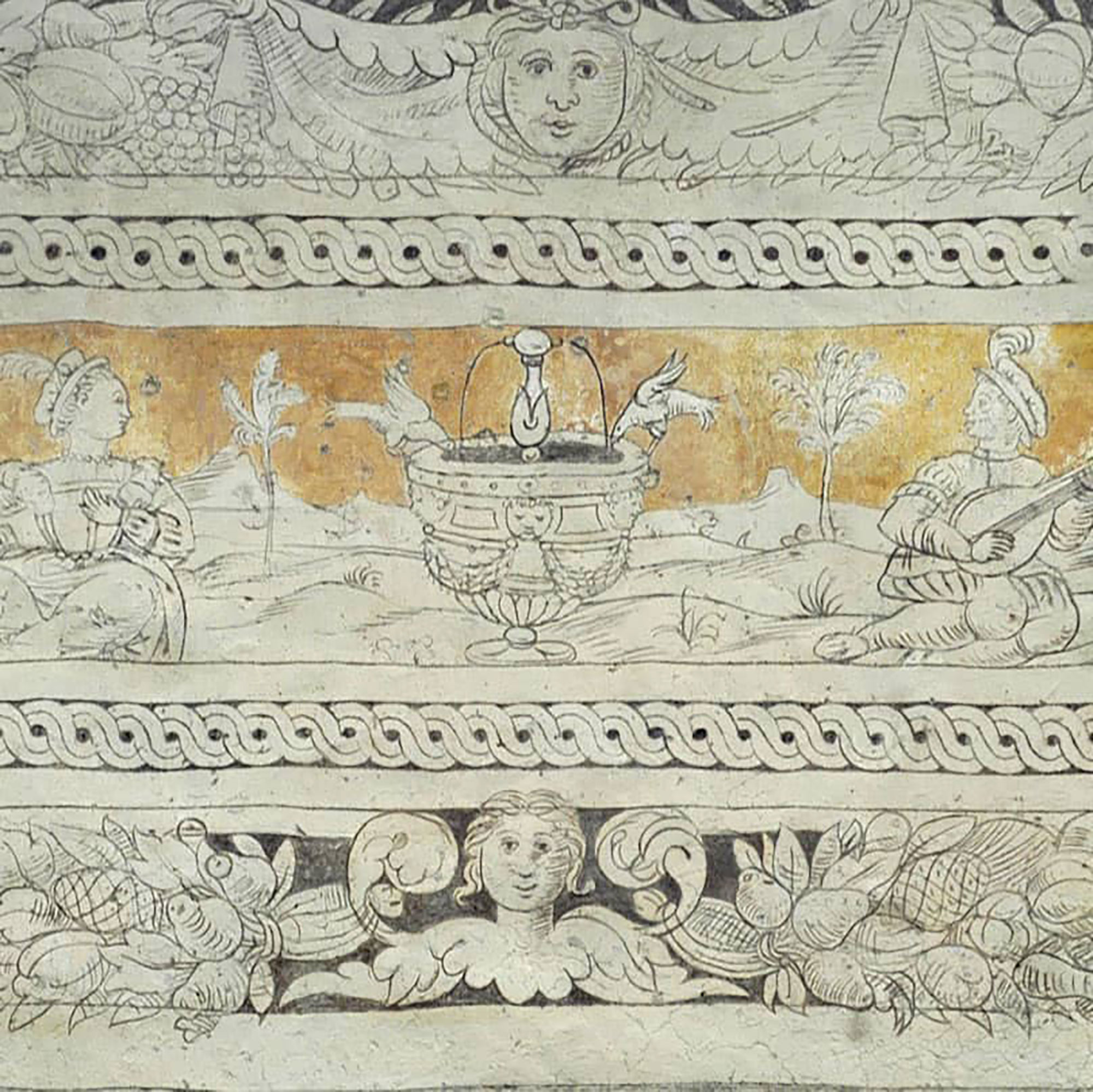
The fresh image of the settlement struck the imagination of visitors, and Alberich’s city soon took on new names, from “Massa Nova,” to “Massa Cybea.” The one that stuck most, however, was “Massa Picta” (Massa the painted), by virtue of the abundance of decorated facades, with wall paintings, frescoes or graffiti. The wealthy bourgeoisie and the new aristocratic class thus expressed a tangible sign of the status they had achieved, conforming to Alberico’s taste.
A 1590 proclamation established fines and punishments for those who defaced, marred or offended the “depinte houses,” “nor with hands, nor with crossbows, arquebuses or in any other way throw stones, earth, balls and any other matter.”
This tradition, perhaps derived from the prince’s Genoese heritage, astonished visitors for centuries, but its traces faded away in more modern times: in the historic center of Massa, however, there remain signs, more or less evident, of this past glory. Sometimes these are mere fragments, others traces emerging from repainting or plasterwork, but there is no shortage of more extensive examples of decorated facades.
An agreement between the Municipality of Massa and the University of Genoa has led to a careful mapping of these survivals, among which Casa Landi, a building still occupied by dwellings and businesses, located at the corner of Via Zoppi and Via Cavour, certainly stands out. The name is recent, dating back to the purchase by Don Paolo Landi (1897), and it has been suggested that the small palace was erected by the Ceccopieri family, notables with a long tradition in the ducal Massa. The graffiti decoration includes friezes with allegorical (masks, devils, etc.), zoomorphic and warlike motifs, and crowns with symbols (the peacock, the barrel, the anvil, the obelisk, the eagle) that echo motifs used in the 16th century by the Massese mint related to the celebration of members of the Cybo house. A fragment of decoration, on the facade of Via Zoppi, has been interpreted as a remnant of Alberico I’s feat, the stork on the cube, used before 1573. The whole takes on the characters of a political manifesto, a tribute to the prince and his dynasty, culminating in the juxtaposition with the condottieri of antiquity. In fact, the decoration of the piano nobile (elevation on Via Cavour), includes Hannibal, Scipio l’Africano, Julius Caesar and other historical figures, in an obvious attempt to propose a parallel between the exploits of these and the modern princes of the House of Cybo.
In the frieze on Via Zoppi, on the second level, there is a curious depiction of a branch with leaves bearing the inscription “Borro,” in which the signature of the architect Stefano Borro, or his son Gherardo, active on several occasions for Alberico I in the second half of the sixteenth century, can be recognized.
The Mussi Ayola palace, near the cathedral, also retains large sections of the graffito decoration, in which some of the main constructions patronized by the prince are highlighted, from the convent of San Francesco to that of the Capuchin friars and the Pomerio Ducale, a lush walled garden with orchards and citrus groves, erected by Alberico just outside the city walls.
Finally, along the piastronata, an ancient path that climbs toward the Malaspina fortress, is the Maggesi (or della Maggesa) palace, with a beautiful facade embellished with pictorial decorations attributed to Agostino Ghirlanda.
Not much remains of the “beautiful streets, beautiful houses, and painted” remembered by Michel de Montaigne in 1581, but the survivals are of great interest, and certainly deserve to be preserved and rediscovered.
Every year, in the park of Villa La Rinchiostra, the event “Massa Picta the colors of culture” is held, which is inspired by the Renaissance city by offering cultural insights into the history of the area, through meetings and tastings fortnightly, from May to September.