
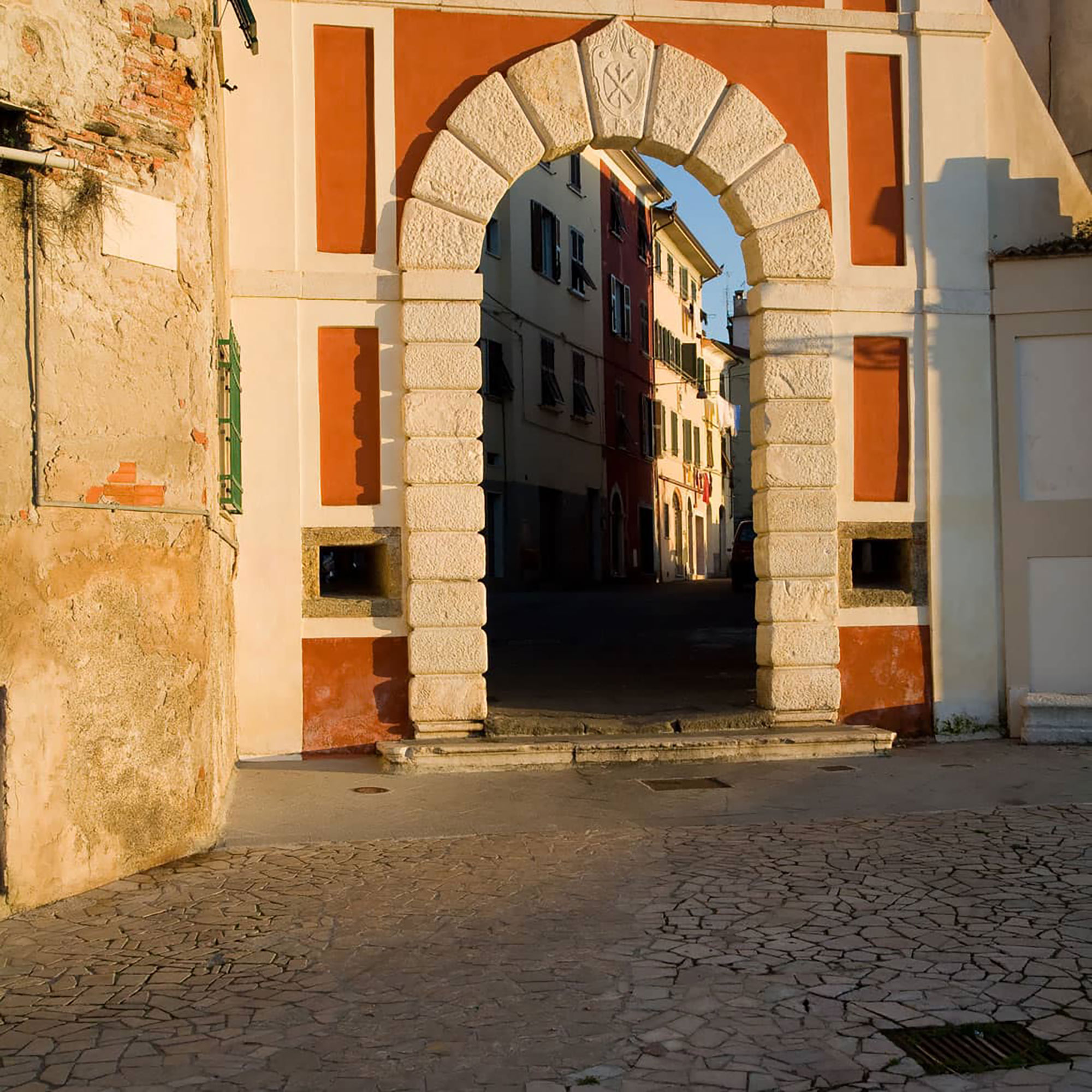
Among the oldest villages in Massa, the name Borgo del Ponte certainly stands out, whose origins date back to the medieval period. The evidence is attested by a document preserved in the Archiepiscopal Archives of Lucca, dated 882, which refers to the desire to found a town around the houses of the Frigido, already called at the time Massa prope Frigidum, located in the locality of Colle or Santa Lucia.
Around 1100 the locality of Borgo del Ponte came to life and began its development with the construction of the hospital and dwellings. It was in the 1300s that the hospitals came to be even two: one depended on the Opera di Santa Maria della Pieve di Massa, while the other on the Opera di S. Maria di Antona. In medieval times, the village was characterized by workshops, commercial and craft activities that made it a particularly active center, and already at that time, it was an important point of convergence for communication routes from the mountainous areas. Routes connected the Ligurian area to Tuscany, and the Via Pedemontana passed through the village, a lesser-known alternative to the more famous Via Francigena, which instead passed through San Leonardo al Frigido. Time then enlarged the village, enriching it with Renaissance dwellings and noble palaces finely decorated with marble details, frescoes and urban works such as the public fountain decorated with an elegant sculptural group and marble rings. It is no coincidence that the village and especially its palaces were painted in particular colors. In fact, the art of painting was a discipline that the town of Massa cultivated over the years, to the point that in 1700 it was called Massa Picta, that is, Massa Pitturata. Sources from the 17th century also discovered the existence of a chapel that had been modified and enlarged several times near San Martino. Also of interest within the historic village are the 16th-century Palazzo Andrei, which still preserves an important marble portal; the Alberico I Cybo-Malaspina arch erected in 1574; the 16th-century bridge church; and the Villa della Cuncia built in 1557.
The village’s roots, however, are not only preserved through urban and architectural works. Life within the medieval core is also made up of festivals and traditions that are still celebrated and maintained, such as the feast of St. Martin the patron saint of Borgo del Ponte, which is celebrated on November 11 amid lights, tastings and general merriment.
For those who feel the need to stay in touch with local nature, on the other hand, the paths leading to and Ortona and Castagnetola are ideal for hiking. Crossing the paths and the bridge over the Frigido, it is possible to venture into the woods of the valley in the heart of the Apuan Alps, an alternative to those who especially in summer feel like enjoying the fresh mountain air.