
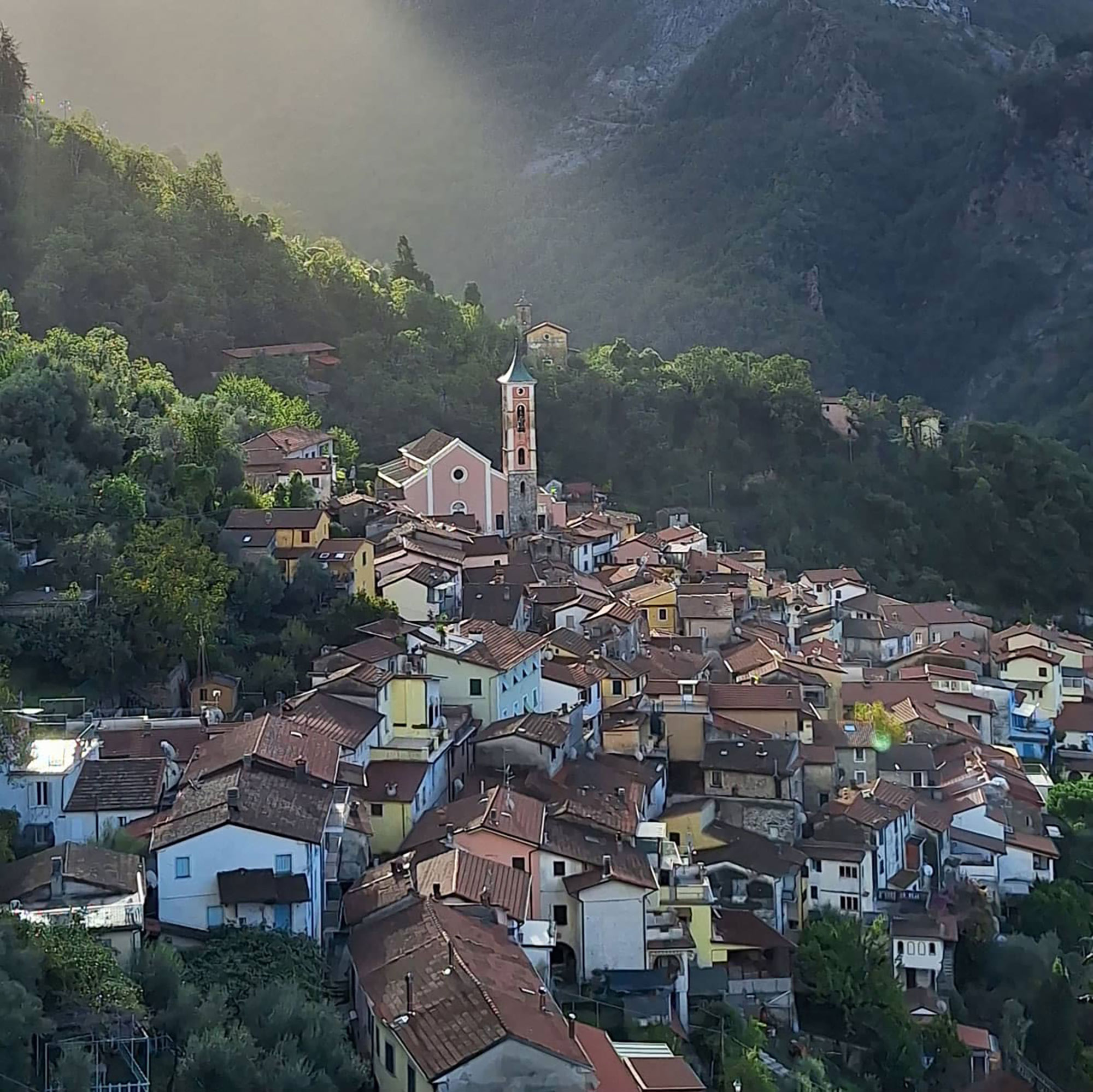
Antona, a hamlet of the municipality of Massa located in the Apuan Alps, has origins dating back to ancient Antognano, as revealed by documents dating back to 988.
During the Middle Ages, it became known for its activities related to textile and wool processing, as well as activities related to traditional agriculture. In the 16th century, the hat industry and other activities related to leather and wood processing developed instead.
In its interior, the town preserves works and buildings from the Medieval period, such as the church from the Romanesque structure of San Gemignano, dating from 1297 and then modified only in the 16th century. Themodifications made the church even more valuable, with the addition of works from the Renaissance period such as: the marble altar dedicated to the Virgin of the Rosary from 1711, marble capitals from the 16th century, two marble statues and a glazed terracotta altarpiece from 1622, depicting the Madonna and Child with Four Saints by Benedetto Buglioni.
In addition to the church, a unique historical testimony of the Medieval and Renaissance period among the Alps, the hamlet also holds the Piccianti mansion, dating from the 15th to 16th centuries.
Indeed, it is not uncommon to find stately villas among the woods of the Alps: as well as for Seravezza, in the 17th century, Antona became a resort for the Malaspina family, lords of the marquisate of Massa-Carrara. In its pristine, cool and regenerating spaces, the nobles found the tranquility that could not be found within the city. Antona, between the sea and the mountains offered them an ideal climate to regenerate their thoughts. Testimony to the Malaspina’s stay in the small village is also the installation of a fountain in the center of Piazza San Rocco, still present today. During the Resistance period, on the other hand, Antona distinguished itself as a center of partisan actions, managing to offer refuge to people fleeing persecution. To this day, the village’s valor is evidenced by a memorial plaque at La Tecchia Memorial. The memorial commemorates the partisans who fell in Antona and the gold medals for military valor.
In addition to this, several trails open from Antona leading to places such as Canevara and Pian della Fioba, known for the Pietro Pellegrini Botanical Garden, which were crucial during the siege of World War II. The Sentiero della Libertà (Freedom Trail), one of the best known, was the route followed by numerous people who migrated to the Allied troops at the Seravezza location.
In Tecchia, on the other hand, there is another small shrine dedicated to the Freedom Crossings, created by the local ANPI. From the locality opens the path leading to the Python Pass, a pass made accessible by the partisans and one of the most used to cross the Gothic Line. At the time it was certainly not valued for the view the pass presented, but today, always keeping in mind what the pass represented, the trail presents a panoramic view of the Apuan ridge stretching from Sagro to Contrario, Tambura, and Altissimo, which formed the German defense line.
Despite Antona’s complex memory, its traditions that have remained unchanged over time form a fundamental part of popular culture: The May, is an ancient treat dedicated to spring and celebrates the country’s agrarian roots. On feast days, visitors to Antona can enjoy the impromptu performances that villagers are wont to put on, wearing self-made costumes and celebrating stories in verse.
There is also no shortage of traditional chestnut harvesting, a collective ritual during which, in the past, Antona residents would pool all the fruit they harvested. The chestnuts were dried for forty days, with a fire constantly burning. The skin was then removed by beating the chestnuts collected in sacks, and the fruits were divided according to each family’s share and taken to the mill to obtain flour.
Today, chestnut harvesting has been incorporated into the Sagra del Neccio festival held in August. Those who visit Antona can enjoy the festival for three days by entering an atmosphere of dancing, traditional songs and heady scents. Those who love the delicate taste of chestnuts will be able to enjoy them in different ways: roasted chestnuts, castagnacci, and chestnut cakes are present to bring the event to life to the fullest.