
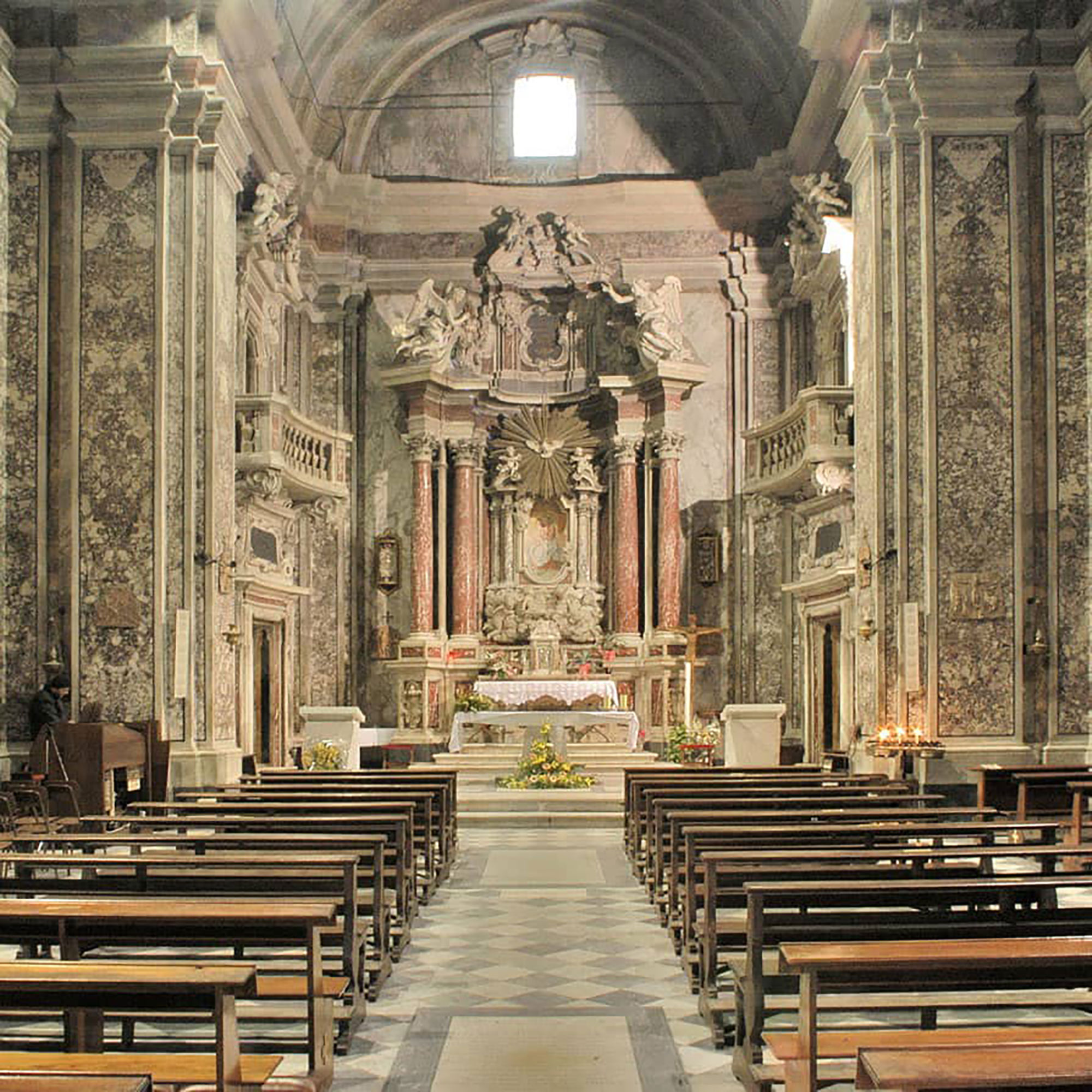
Located just outside Carrara’s Renaissance walls, along the route of the ancient Via Carriona (the first road link between the city and the sea), the Sanctuary of the Madonna delle Grazie hides, behind its modern façade, a richly decorated interior steeped in history.
The building was consecrated in 1676, ruled by the first duke of Massa and prince of Carrara Alberico II Cybo Malaspina, based on a design by architect Alessandro Bergamini: the intent, shared by “Authority and People,” was to shelter in a worthy home a venerated Marian image, preserved in a dilapidated oratory located on the Groppoli site, a little further downstream from the present building. A plot of land located at the confluence of the Ninfale canal and the Carrione stream, in the (now fully urbanized) suburb of “Lugnola,” was chosen for the new church.
Thesquare in front of the sanctuary has a modern appearance, with the monument to St. Francis (1986) by Stefano Cavallo (1913-1996), the linear facade (1960) designed by architect Ottaviano Matelli, and the bronze portal, with stories of St. Francis and a curious Christ protecting the city of Carrara (1970), by Vittorio Tabaracci (1928-2014) .
The interior, on the other hand, is a triumph of colorful and rare marbles: not only the more classic local varieties and Versilian breccias, but a veritable assortment of marbles, both Italian and foreign. This profusion of exotic materials is linked to the prolonged intervention of the family of the Del Medico counts, quarry owners and great merchants whose trade extended throughout Europe, with branches in Venice, Naples, and London: the munificent handouts of the Del Medico family accompanied the history of the church from its construction until the late eighteenth century, profoundly affecting its sumptuous appearance.
The architect Bergamini himself had married a Del Medico (in 1686), and it is not surprising to find his name juxtaposed with the design for the high altar, executed at the turn of the century. The design refers, in a highly symbolic way, to that of the Chapel of the Princes in San Francesco in Massa, due to the Lucchese architect Domenico Martinelli (1650-1718). The detached 16th-century fresco of theMadonna and Child constitutes the devotional and visual culmination of the sanctuary, and is enhanced by the dossal with a triumph of marble cherubs, and the dove of the Holy Spirit appearing in the center of a golden ray. The side portals, and the tribunes, with the singular course of the upper openings, recall the structure of the altar, going to form a unified and majestic whole. The rich sculptural apparatuses help animate the whole, generating a movement that extends to the architectural elements, with a three-dimensional effect that has been likened to the works of Borromini.
Thedecorative apparatus extends to the entire body of the church, including the covering of the side walls and the four large confessionals, above which insist as many canvases: near the chancel Annunciation and Rest in Egypt, by Livorno painter Pietro Milani (mid-19th century), toward the orchestra Escape to Egypt (right) and Nativity (left), valuable 18th-century canvases once placed on the side altars . The latter still preserve, above the niches occupied by modern devotional sculptures, the ovates with God the Father and theEcstasy of St. Catherine that accompanied the above canvases .
Finally, on the right altar are two cherubs of very fine workmanship, traditionally attributed to the ornate sculptor Bartolomeo Cassarini (†1773). On leaving the church, however, the contrasting whiteness of the imposing neoclassical orchestra in white Ravaccione marble, donated by the wealthy merchant Pantaleone del Nero in 1830, is striking.