
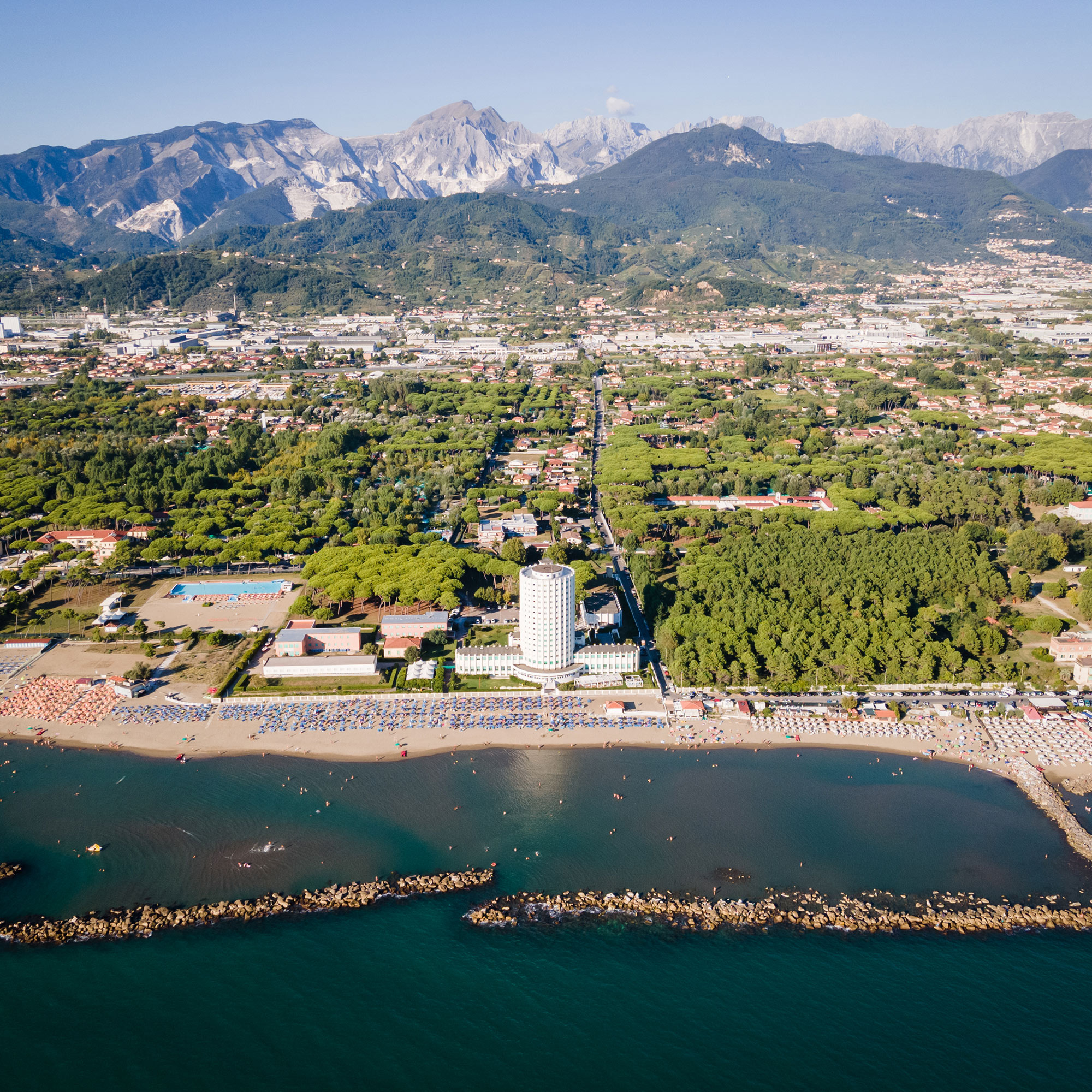
In the northern resort of Marina di Massa, also known by the name of Partaccia, there is a cylindrically shaped structure positioned between the sea and the pine forest, which not only preserves with it a piece of local tourism history, but has also become over time a cultural landmark of the Apuan Riviera: it is the Torre Fiat, or Colonia Edoardo Agnelli.
Its origins are to be found in the idea of engineer Vittorio Bonadè Bottino, who in 1933 on the initiative of Edoardo Agnelli decided to take the cylindrical shape of the Duca d’Aosta Hotel in Sestriere (taken care of by the same engineer in 1932) and create a new building intended for the summer stay of the children of FIAT employees. Inside, the Tower was built in a helical shape and as a single dormitory. It is 8 meters wide and 420 meters long, and at the time of its design was designed to accommodate about 800 children.
Around the 1930s, in fact, Marina di Massa experienced a decidedly important period for tourism: the seaside area began to be equipped with bathing establishments, villas, and in this case even colonies. Spending time outside the city and taking refuge in this small bucolic corner, between the sea and the mountains and where the air is always fresh, gave children the chance to live happy and carefree days away from the chaos of the ever-moving cities. The resort’s traditional, healthy food and playful activities also provided an opportunity for them to experience a form of modernity and organized social life while maintaining friendly discipline.
Outside the tower, children could enjoy the sea within walking distance, take a bath, breathe healthy and fresh air to regenerate the mind, but also enjoy the beautiful pine forest that characterizes the entire Partaccia area. Similar to school, the colony’s goal was to socialize young boys and girls, keep them entertained and but following strict, if not necessarily strict, rules: one was still on vacation.
In the course of time, during the postwar period and up to the 1970s, the colonies continued to function according to the principles established in the previous decades, but in the following years, both the community of reference and the social role of the company began to change, and the facilities began to go into crisis. In the postwar phase, changes were also made to the interior of the tower; the glass cement covering the inner well was removed and the dormitories were divided into smaller spaces, each with 4 beds and a bathroom with shower. To this day, the supervisors’ rooms and access to the back stairs remain unchanged. These maneuvers allowed the children who housed there greater freedom of movement.
To date, the Torre Fiat has undergone further changes, the most important of which include its new use. In fact, in addition to presenting the new name, Torre Marina, surely in honor of its geographical location, the building is also part of the Tourist Village entitled Torre Marina. The entire facility is owned by the Verve company and offers a wide range of tourist services. Exactly like the children of yesteryear, visitors to Torre Marina can in fact enjoy the excellent view from the tower. The sea just a few steps away makes for a fun experience while experiencing moments of relaxation. And if one does not feel like experiencing the sea? In that case, no fear. You can take long walks outside and inside the village, relax on the terrace, and why not, even enjoy the excellent attractions the village presents. These include a theater equipped for video projections and lectures, ideal for families who feel the need to rest in the evening without the need to go out, classrooms for educational activities and workshops, sports fields for youth soccer, basketball, volleyball, and beach volleyball. On the other hand, for those who want to have a good swim without, however, having to move to the beach, Torre Marina also presents a large swimming pool, where it is possible to stay accompanied by a good book, in the company of cool drinks to be consumed in the shade of the pine forest.