
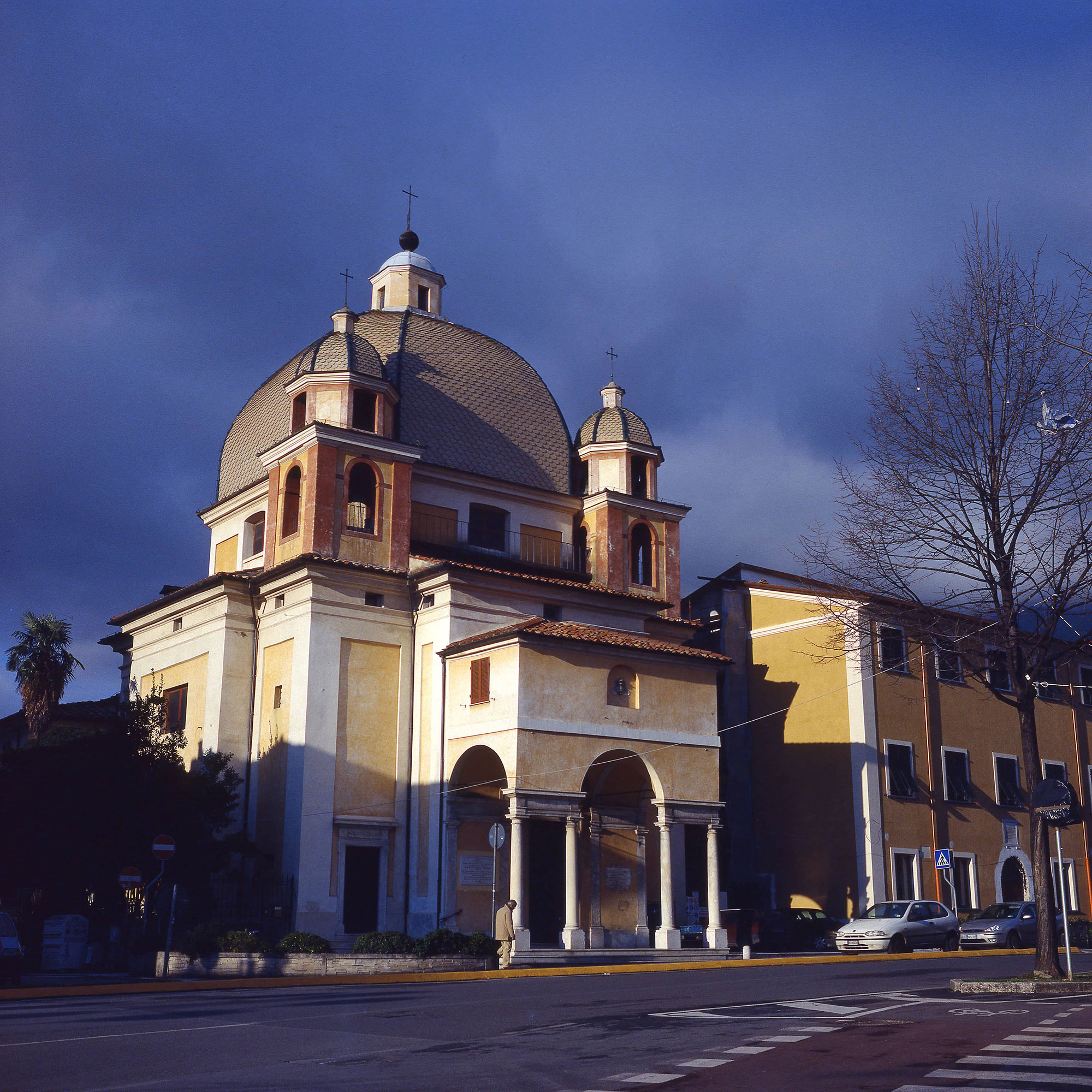
A missive dated Oct. 30, 1628, preserved in the register of the Curia Lunense, suggests the construction of an oratory by Gian Francesco Bergamini at the behest of Charles I Cybo-Malaspina to house the apparition of the Madonna della Misericordia in gratitude for ending a long drought in the region during 1627.
Work on the Misericordia church outside the city walls began in late 1628, while in 1630 in honor of the sacredness of the Madonna a fresco of the figure, dated 1627, was officially transferred to the church. A few years later Cardinal Gian Domenico Spinola, Bishop of Sarzana consecrated the church, and by 1640 the structure underwent further changes: the first bell tower was erected, several relics of the saints were placed inside, and the artist Mattelli was commissioned to paint the canvas of St. John the Baptist. It was not until 1744, however, that the church took on the appearance it still retains today. Currently, its interior features marble sculptures such as a washstand dating back to the 17th century and a marble stoup donated by the city of Carrara.
In addition, the church houses paintings by masters of the period, including The Nativity by Cardi Cigoli and The Madonna of the Snow by Domenico Fiasella, also known as the Sarzana. On the outside, on the other hand, the two bell towers have a structure divided into two distinct levels: the lower level has single-lancet windows, while the upper one possesses an octagonal shape.
During the 19th century, the Confraternity of Mercy linked to the shrine played a fundamental role of the course of the cholera epidemic: in fact, it was the only institution in Massa to take care of the transportation and burial of the dead belonging to both richer and poorer families. Its activities were later interrupted in 1944 due to the war, which also involved Massa.
Affiliated with other Misericordie in Italy and around the world, today the Confraternity is back in operation, representing a Christian-inspired aggregation with an important impact on the Massa area. The voluntary work done by Confraternity members is essential to foster spiritual and material good in the community. Through assisting the needy, supporting the elderly, those in need, and promoting cultural and religious initiatives, the Confraternity of Mercy contributes to improving the quality of life of the citizens of Massa through the Christian principles of love and compassion.