
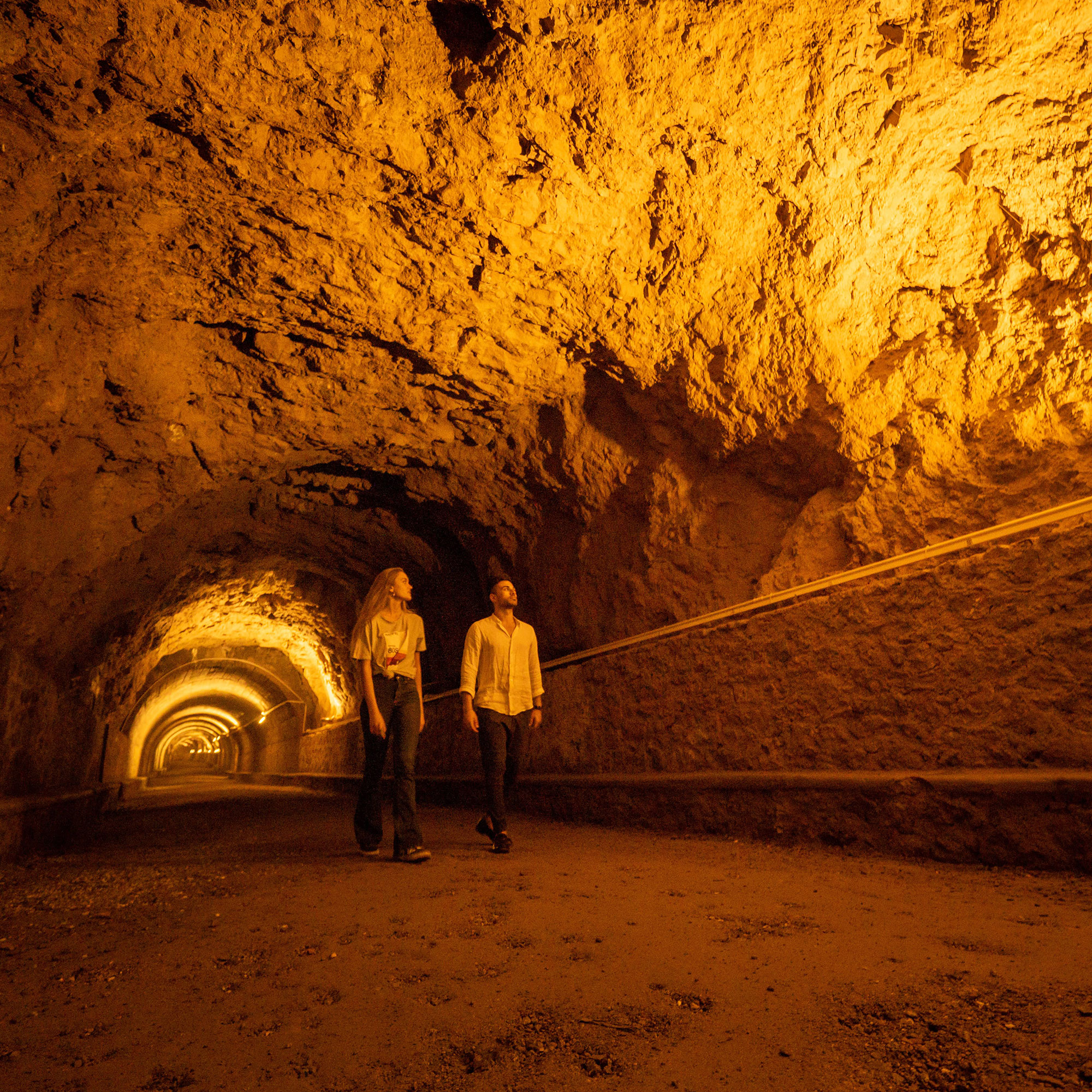
During World War II, the construction of air raid shelters was essential to protect civilians from the relentless bombing that ravaged the nations involved in the conflict. Among these, the Martana Anti-Aircraft Shelter in Massa represents one of the city’s most prominent historical sites.
Located in the heart of the historic center, on Via Bigini, the Martana Antiaircraft Shelter is the largest antiaircraft shelter in Massa, capable of housing thousands of people. Its construction, which took about a year between 1942 and 1943, was entrusted to miners from Belluno. The decision to excavate the shelter in the Martana rock proved to be strategic to ensure adequate protection from aerial bombardment. In fact, the shelter consists of a 450-meter long tunnel dug into the rock, equipped with three entrances. Along the vault of the tunnel are artificial openings that served as ventilation chimneys, ensuring a constant exchange of air inside the shelter. This design made it possible to keep the environment livable even in the presence of many people.
After the German military command ordered the evacuation of the city in September 1944, the shelter was occupied by Nazi forces, who established field kitchens and housed soldiers engaged in guarding the Gothic Line there. After the end of the conflict, the shelter remained closed for sixty years, until 2006, when it was recovered for cultural and educational purposes. Currently, it is run by the Sancho Belly Cultural Association, which organizes guided tours, exhibitions, theatrical performances, concerts and book presentations. This shelter has become an important cultural and historical center for the city.
Today, walking through the tunnels of the shelter is a valuable opportunity to understand the anguish experienced by the population during the air raids. During attacks, entire families would take shelter in these rooms as soon as they heard the sound of sirens. Photographs and video interviews projected at the beginning of the visit offer a firsthand account of the wartime experiences of the citizens of Massa. The guides’ accounts illustrate how the population flocked to the shelter, seeking safety in its dark tunnels.
The refuge represents not only a place of remembrance, but also a symbol for the Massa community. It is a living history lesson that reminds new generations of the sacrifices and suffering of the past, serving as a warning against future conflicts and emphasizing the importance of peace and solidarity. Thanks to recovery and enhancement efforts, this historic site thus remains a source of inspiration and reflection for all visitors.
Info and reservations:
Associazione Promocultura Società Cooperativa arl
- 347-8163224
- ram@promocultura.it
Opening Hours:
- 15 September / 13 June:Saturday afternoon from 15:00 to 18:00
- 14 / 17 June 2024: 18:00 / 23:00 (special openings during Spino Fiorito)
- 18 June / 14 September: Friday and Saturday evenings from 21:00 to 24:00
Special openings by reservation for school groups, municipal summer centers, and groups in summer and winter.
Special openings during the following official celebrations and city events:
- 27 January – Holocaust Remembrance Day
- 10 February – Day of Remembrance
- 10 April – Liberation of Massa
- 25 April – Italian Liberation Day
- May – FAI Spring Days
- 16 September – Massacre at the Fosse del Frigido
- 4 October – Feast of Massa’s Patron Saint, St. Francis
- 14 and 15 October, FAI Days 2023: 10:00-13:00 / 15:00-18:00
- October – Night of Museums