
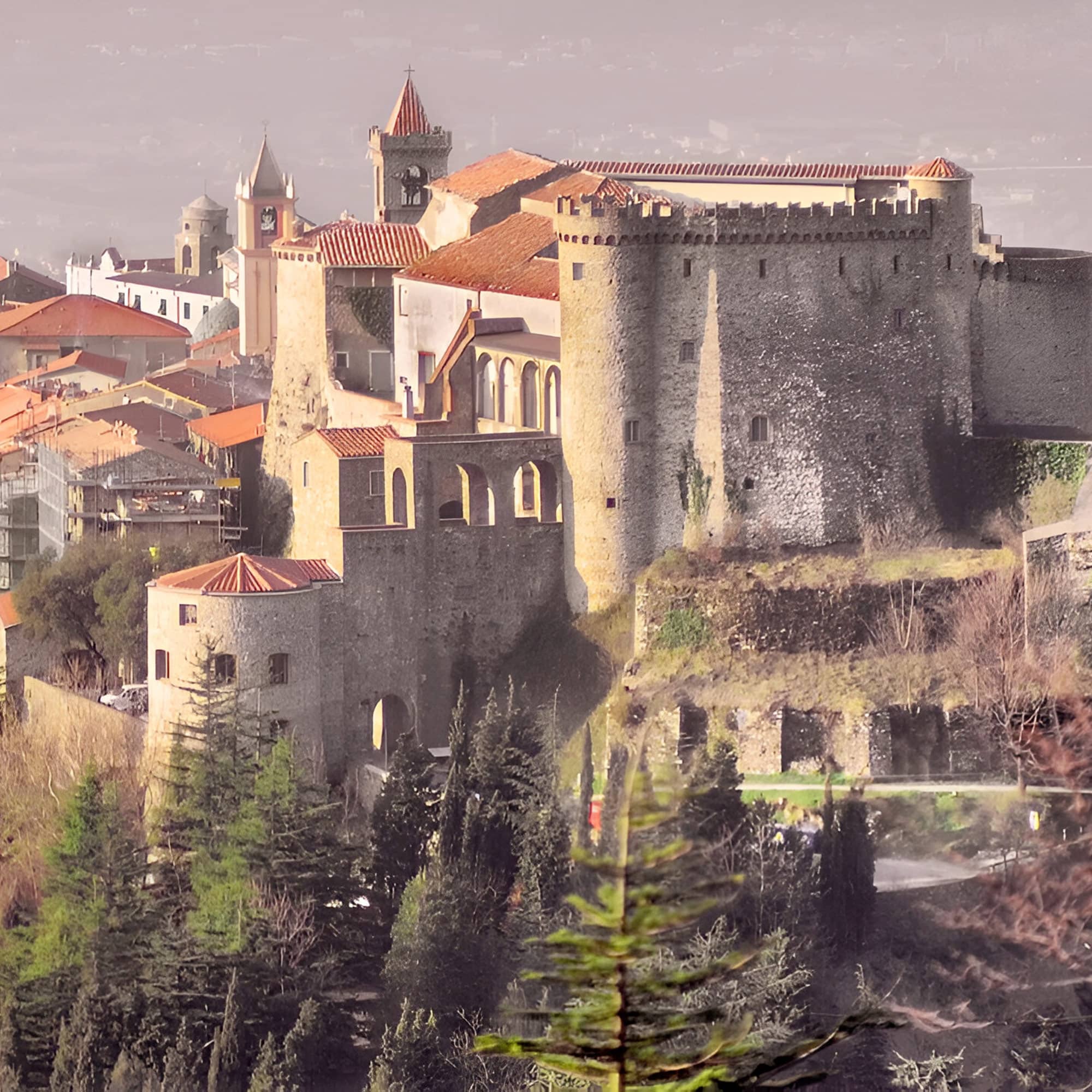
Fosdinovo is an ancient town of medieval origin whose hilly area dominates the plains of the Val di Magra and Luni valleys; it has always been the gateway to Lunigiana, placed as it is on the border between Tuscany and Liguria, between the mountains and the sea.
The name comes from the term “fosdenova” (from “fauce nova”), meaning “new pass,” because from here and thanks to the fortress that dominates the village and the valley, a safe passage between the hinterland and the coast developed.
The first news of the Castrum Fosdinovense date back to 1084, and we know that in 1124 the fortress, now a tourist destination of high historical value, had already been erected to protect the village, commissioned by the Malaspina family, who at that time were lords of Lunigiana and moved their residence here, making Fosdinovo the political and military center of the fiefs entrusted to them from the early 14th to the 18th century.
Walking through the village of Fosdinovo takes you back in time, the quiet atmosphere, the almost total absence of cars, the slow pace of time.
The main place of historical and artistic interest is certainly the Malaspina Castle, which welcomes visitors at the beginning of the historic center of the village. It is one of the most important and best-preserved castles in Lunigiana and Val di Magra and its origin dates back to the 12th century. Raised on a spur of rock, it seems to rise directly from the sandstone and dominates, with its imposing bulk, the village and the valley. What for its builders was a strategic fact, namely, the fact that it dominated the entire valley, today is a comfort for the eye, because already from the courtyard the view of the mouth of the Magra and the Gulf of La Spezia with its islands is fascinating.
The castle has a quadrangular plan and over the centuries it was fortified and enlarged several times until, in the 16th century, it became a refined aristocratic residence in pure Renaissance style, considered one of the finest stately homes of the time.
One of the castle’s special features is the “Dante’s room” where it is said that Dante Alighieri stayed, as a guest of the castle, during his own exile from Florence, and although there is no irrefutable historical evidence of such a stay it is plausible since in fact the supreme poet’s friendship with the Malaspina family is recounted by Boccaccio and Dante himself mentions the castle and the Malaspina family in the Divine Comedy. According to one legend then, the ghost of Bianca Maria Aloisia Malaspina, the marquise who was walled up alive by her father for falling in love with a stable boy, still roams the halls of the building, and there are those who are ready to swear that on some evenings she can be heard singing on the castle walkways.
Today the castle is still owned by the Marquises Torreggiani-Malaspina and can be visited with a guided tour by reservation; the upper floors house a charming Bed and Breakfast.
Another place to see without a doubt is the church of San Remigio, which certainly dates back to the 12th century, as does the entire village, but was completely rebuilt at the end of the 16th century and took on its present appearance in 1684, when it was enlarged and raised above the road by a Carrara marble ramp. Inside it preserves a 17th-century silver reliquary containing some remains of the saint to whom it is dedicated, as well as the beautiful funerary monument of Galeotto I Malaspina, the village’s first marquis, commissioned in 1367 by the Malaspina family from an unknown Lombard sculptor and consisting of a white marble aedicule with a rose window and a sarcophagus on which the late marquis Galeotto is depicted in arms, underscoring the origin of the family’s power.
In the bas-reliefs below, the deceased is carved in the guise of a knight in the act of investiture in the presence of the Virgin, Christ, St. John the Baptist, St. Anthony and St. James the Apostle, the saints to whom the main orders of knighthood in the Middle Ages were devoted.
Inside the church you can also admire a splendid bas-relief by the Carrarese sculptor Giovanni Baratta depicting Our Lady of Suffrage, an 18th-century organ made by the famous Serassi family of master organ makers, and the 16th-century baptismal font. Also worth a visit is the Oratory of the Company of the Whites, abutting the church of St. Remigio, the construction of which is later than 1501, the year in which the previous oratory of the Company was destroyed. The white marble facade dates from the second half of the 17th century, and the Baroque interior houses polychrome marble altars set against the side walls. At the high altar is a beautiful 15th-century wooden statue of the Virgin, which was moved here from the church of San Remigio following a fire that spared it.
Also worth a visit is the Oratorio dei Rossi, which is directly connected to the church of San Remigio and dates back to the 17th century: worth seeing inside is the Baroque altar and the fine 17th-century wooden crucifix. The difference between the two confraternities, Bianchi and Rossi, seems to have been social: while marquises, nobles and wealthier families belonged to the Bianchi, humbler people were part of the confraternity of the Rossi.
The hamlet of Fosdinovo is surrounded by forests and completely immersed in nature, and loop trails that are practicable even by untrained legs depart from the hamlet and lead to other notable medieval hamlets in the municipality, such as Giucano, Pulica, and Ponzanello.